
JUNO Collaboration Releases First Physics Results, with Major Contributions from Subatech.
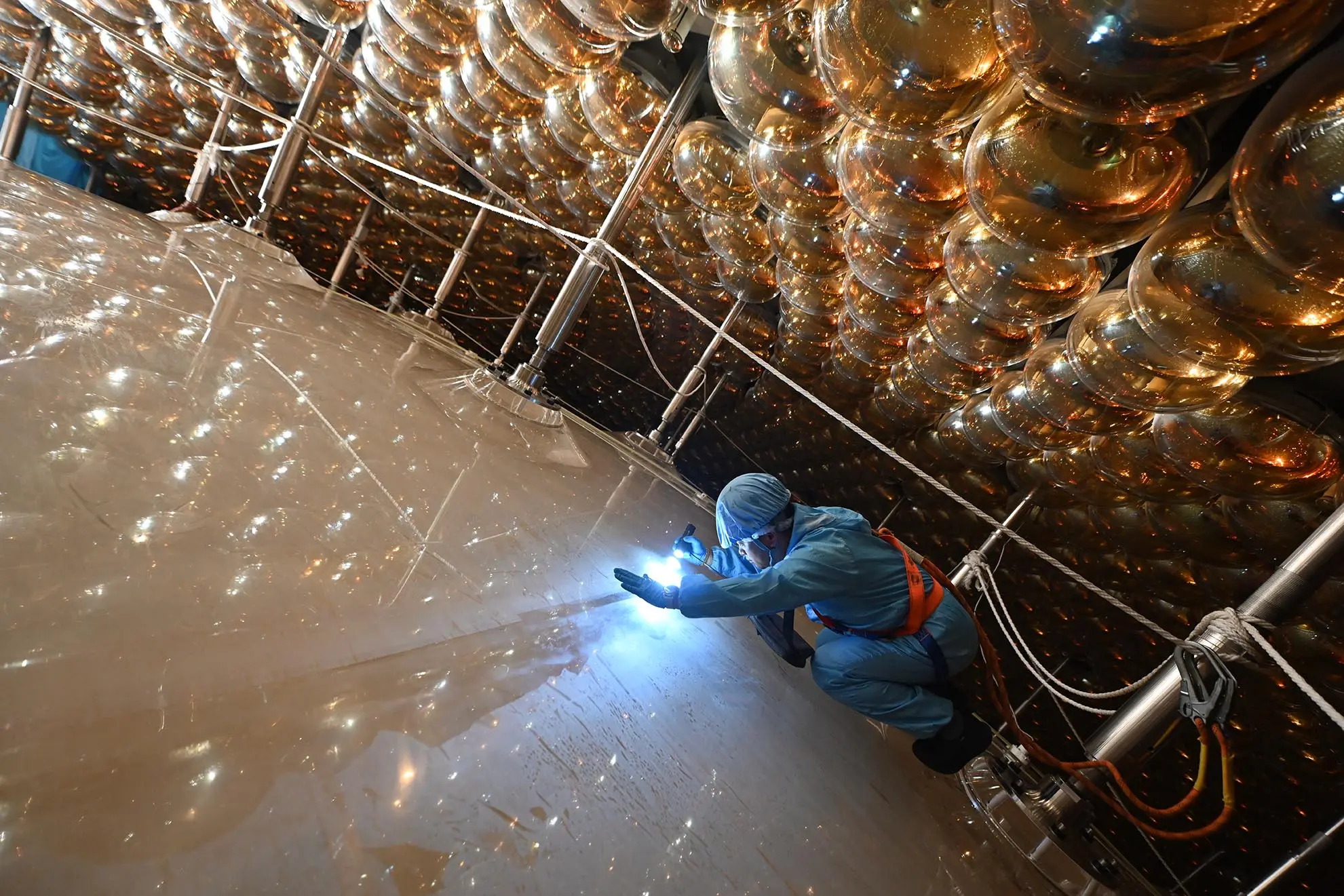
Using data collected between August 26 and November 2, 2025, corresponding to only 59 effective days of operation, JUNO has measured the so-called solar neutrino oscillation parameters, θ₁₂ and Δm²₂₁, with a precision 1.6 times better than that of all previous experiments combined. This result confirms the previously reported mild tension between measurements based on solar neutrinos and those based on reactor antineutrinos, a question that JUNO is uniquely well positioned to address thanks to its simultaneous sensitivity to both channels.
Detector performance and the first physics results were submitted for publication on November 18 and made available on the arXiv preprint server [1,2].
Improving the precision on solar neutrino oscillation parameters makes it possible to explore neutrino fundamental physics in greater depth, to strengthen the global consistency of oscillation results, to fully exploit neutrinos as probes of the Sun, and to secure the precision goals of current and future large-scale experiments.
Subatech Contributions to the First JUNO Result
Subatech, Nantes Université, IMT Atlantique, CNRS IN2P3, has been deeply involved in the JUNO experiment since 2014, with contributions spanning detector instrumentation, statistical analysis, and physics interpretation.
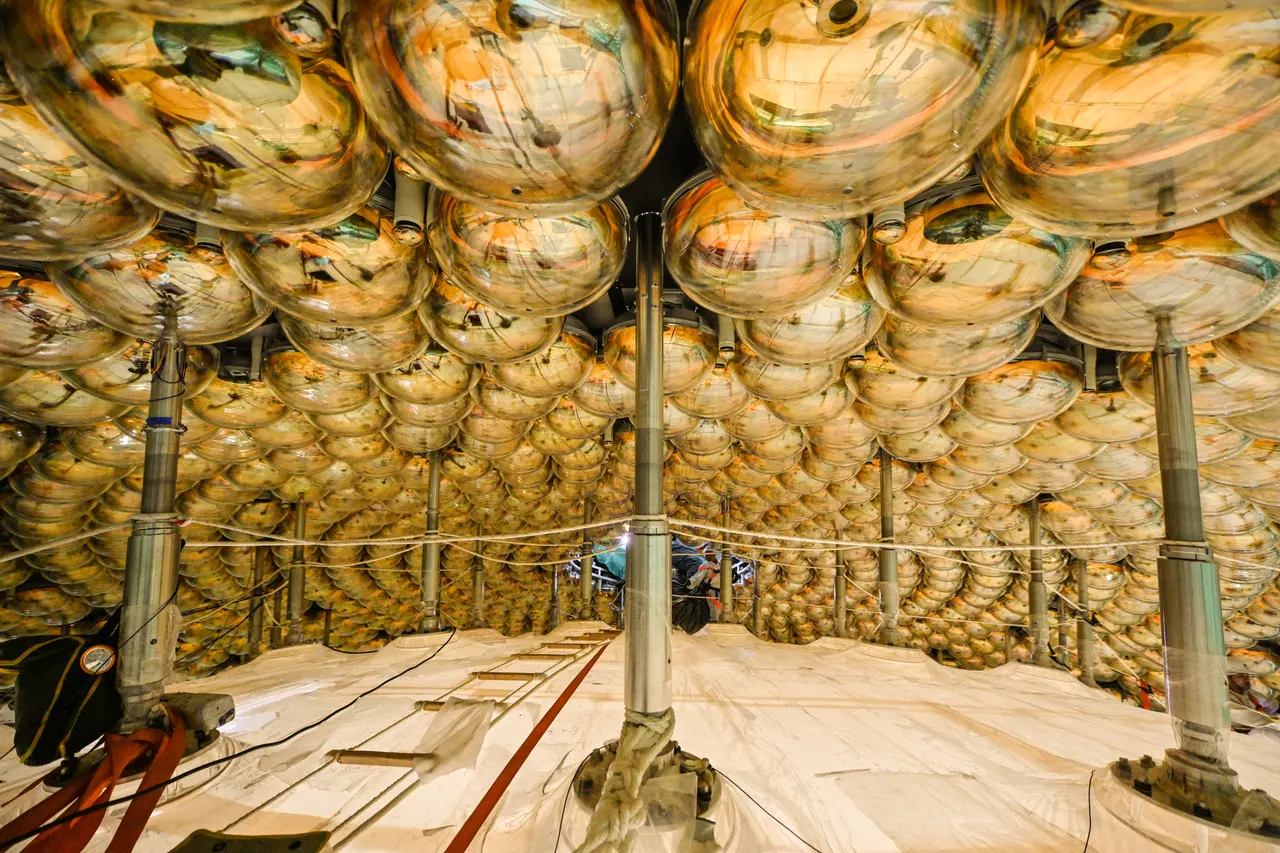
In close collaboration with the APC and IJCLab teams, Subatech has also been involved in major strategic developments of JUNO. Under the leadership of the APC and IJCLab team, Subatech participated in the conception, development, and coordination of the dual calorimetry detector design, a first of its kind, approved by the collaboration in 2015. This development introduced a new major auxiliary subsystem into the experiment, consisting of about 25,000 three-inch photomultiplier tubes, or small PMTs, providing a complementary and precise energy calibration to the main system based on large PMTs [3,4]. Subatech was actively involved in this effort, both scientifically and methodologically, and contributed to establishing dual calorimetry as a central element of JUNO precision physics. Beyond high precision calorimetry for reactor neutrinos, the dual calorimetry detector enhances JUNO capabilities for proton decay searches [5] and for precise cosmic muon tracking.
In addition, in collaboration with APC, IJCLab, and LP2i Bordeaux, the latter being responsible for testing, recent developments, and construction of the small PMT system, Subatech contributed to the testing and validation of the CATIROC readout ASIC used on the ABC electronics board, designed by the APC team in 2014 and 2015 for the small photomultiplier system [6]. This electronics chain is a key element of JUNO dual calorimetry and is already used in the calibration of the large PMT system employed in the first JUNO publications.
From the analysis point of view, Subatech and APC and IJCLab jointly played a leading role in JUNO sensitivity studies to solar oscillation parameters, including the 2021 sensitivity paper on θ₁₂ and Δm²₂₁ [7], which laid the groundwork for the first physics results currently being published.
"Our Subatech neutrino team contributed to the first oscillation measurement in three complementary ways", said Professor Frederic Yermia from Nantes Université, head of the Subatech neutrino team. The group participated, in close collaboration with APC and IJCLab, in the development and validation of the statistical methods and analysis tools used to extract oscillation parameters from the reconstructed antineutrino energy spectrum. In particular, Subatech played a key role in the statistical sensitivity studies that identified which parameters could be robustly measured with a dataset limited to only 59 days. "These studies directly motivated the decision to focus on the measurement of solar oscillation parameters", added Professor F. Yermia.
In addition, the Subatech team designed the so-called bias control procedure, which was adopted by all JUNO analysis groups. "This common framework is a critical element to guarantee the robustness and reliability of the reported results", added Benoit Viaud, CNRS, member of the Subatech neutrino team.
Towards a Long-Term Physics Program
JUNO is designed for an expected scientific lifetime of about ten years. The experiment will determine the neutrino mass ordering with at least 6.5 years of nominal exposure, measure oscillation parameters with sub percent precision, study solar, atmospheric, supernova neutrinos and geoneutrinos, and search for phenomena beyond the Standard Model. Subatech will continue to play an active role in JUNO through high precision analyses, instrumental studies, and the training of young researchers. Together with IJCLab, in France, Subatech leads a subgroup of scientists from more than seven countries across three continents, engaged in an effort to further exploit the scientific potential of JUNO [8].
Références
- [1] arXiv:2511.14590 https://arxiv.org/abs/2511.14590
- [2] arXiv:2511.14593 https://arxiv.org/abs/2511.14593
- [3] JHEP 03 (2021) 004, DOI: 10.1007/JHEP03(2021)004 https://link.springer.com/article/10.1007/JHEP03(2021)004
- [4] JHEP 2024, 2 (2024), DOI:10.1007/JHEP12(2024)002 https://link.springer.com/article/10.1007/JHEP12(2024)002
- [5] Chinese Physics C, DOI: 10.1088/1674-1137/ace9c6 https://iopscience.iop.org/article/10.1088/1674-1137/ace9c6
- [6] JINST 16 (2021) 05, P05010 https://iopscience.iop.org/article/10.1088/1674-1137/ac8bc9
- [7] Chinese Physics C, DOI: 10.1088/1674-1137/ac8bc9 https://iopscience.iop.org/article/10.1088/1674-1137/ac8bc9
- [8] Sci Rep 12, 5393 (2022). https://doi.org/10.1038/ https://www.nature.com/articles/s41598-022-09111-1