
First results from the eShape experiment!
Understanding the properties of neutrinos produced by nuclear radioactivity is a challenge. During beta-minus decay, an electron and an antineutrino are emitted. Measuring the shape of the electron energy spectrum provides information about the antineutrino energy spectrum, as they share the same decay energy. The quantum properties of nuclei influence the shape of the electron and antineutrino energy spectra. Theoretical predictions of these particular spectrum shapes are inconsistent. The eShape experiment (figure 1), the result of an international collaboration between Subatech Nantes, IFIC Valencia, and the University of Surrey, uses a new detector to measure the shape of these energy spectra.
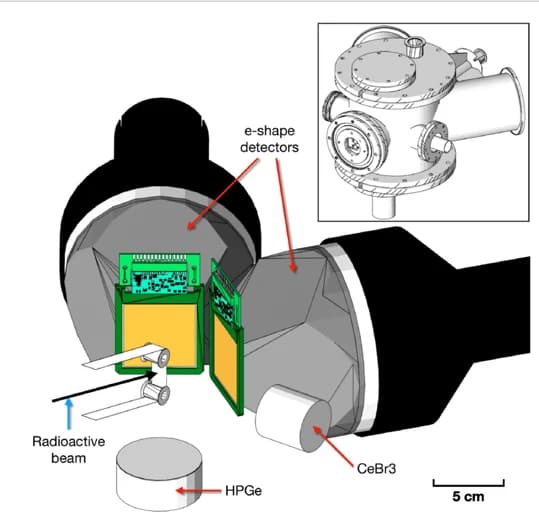
Figure 1 : e-Shape detector, composed of two identical silicon-plastic telescopes. The inset shows the vacuum chamber. This new device was assembled at Subatech, and the laboratory designed and built the associated mechanical, electronic, and DAQ components. Figure taken from [2].
This new device was assembled at Subatech, and the aboratory designed and built the associated mechanical, electronic, and DAQ components [1]. Two experimental campaigns were conducted at the University of Jyväskylä in 2022 and 2023. Our initial results, published in a high-impact journal [2], confirm the corrective factors for beta spectra of one type of transition () (figure2), which account for approximately 60% of the so-called forbidden beta transitions that occur in nuclear reactor fuel.
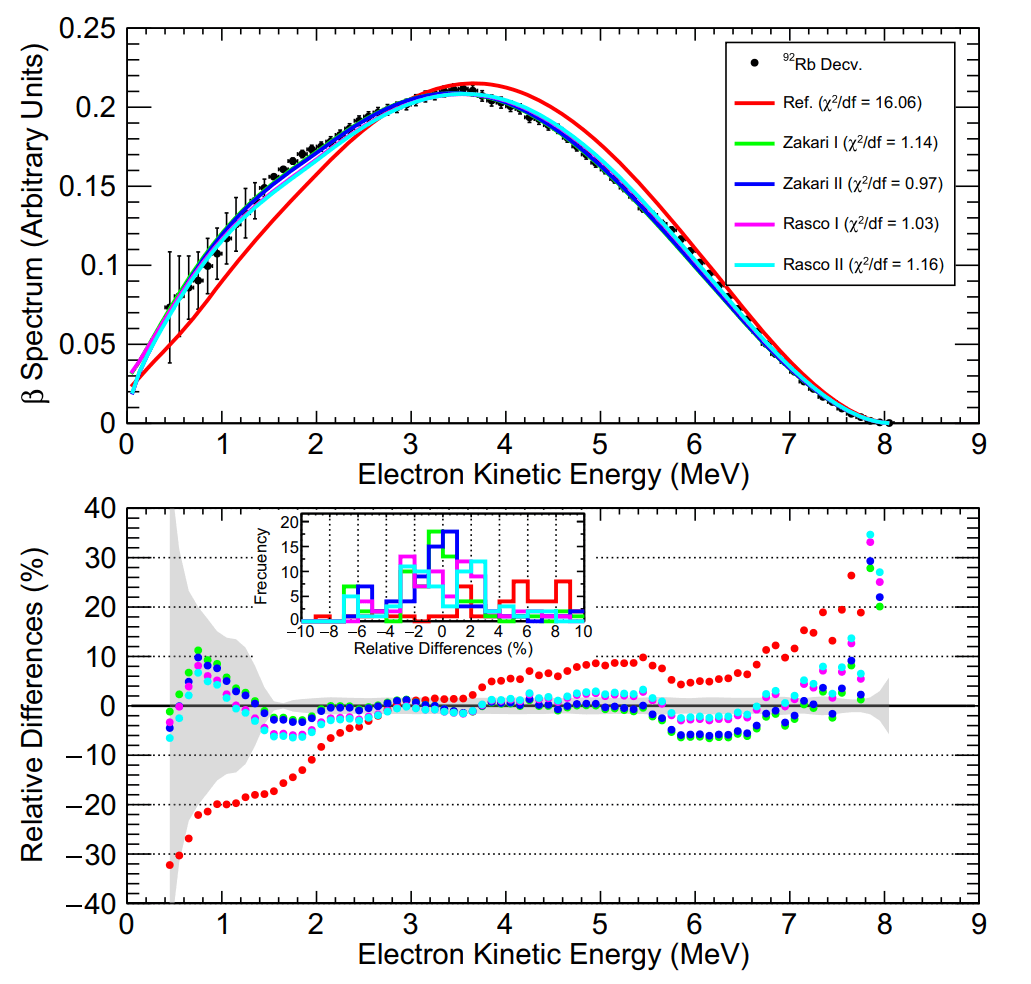
Figure 2 : The shape of the beta spectrum of two of the most relevant decays for predicting the reactor antineutrino spectrum was measured: Rb, Cs. No significant deviation from the allowed shape is observed for these two 0-forbidden first transitions, as predicted by the models. Figure taken from [2].
[1] V. Guadilla et al., J. Inst. 19 (2024) P02027
[2] G. Alcala et al., Phys. Rev. Lett. 135 (2025) 142502