
Fukushima : New Insights into the Dispersion of Radioactive Microparticle
By analyzing 100 soil samples collected in Fukushima Prefecture a few months after the accident, the researchers measured the abundance of these particles and their contribution to the total radioactivity deposited on the ground. The results show that CsMPs formed primarily on the night of March 15, 2011, at the time of the reactor meltdowns, before being transported over a large part of the region by a single atmospheric plume. Unlike soluble cesium, which is typically accounted for in radiological risk assessment models, these microparticles behave differently in the environment: they circulate in particulate or colloidal form and interact differently with soil and surface water. The study also shows that precipitation played a major role in their deposition on the ground, promoting their accumulation in certain areas. This form of contamination, often invisible in conventional approaches based on total cesium, could have a significant impact on the assessment of risks related to ingestion or inhalation following a nuclear accident.
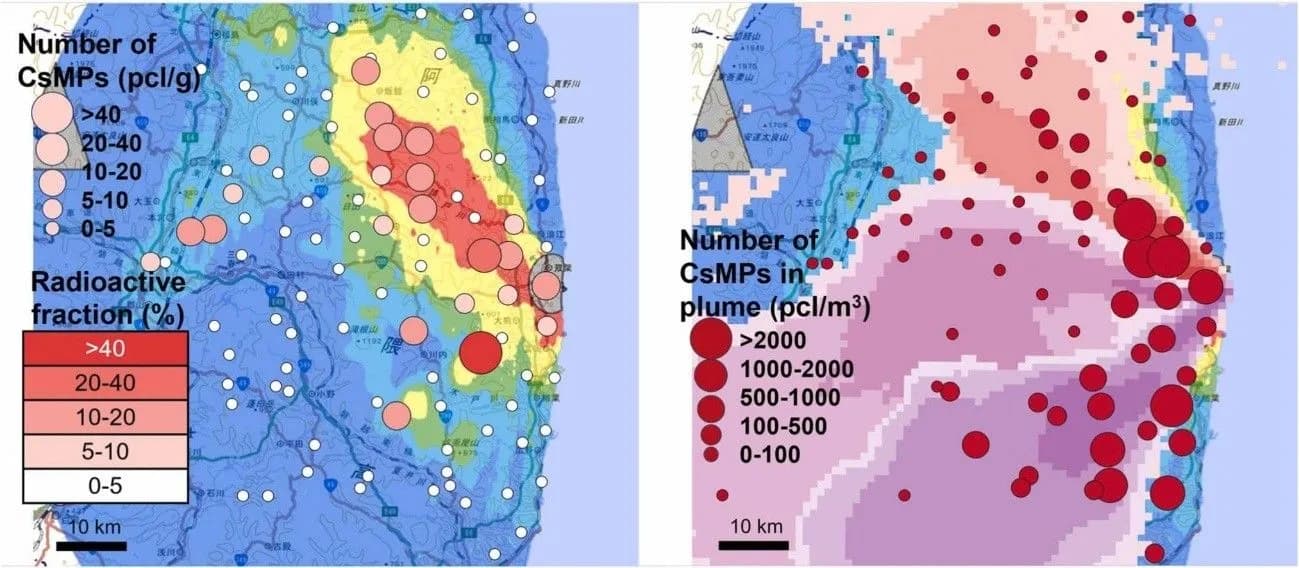
Image description
- Left : The size of the circles indicates the number of CsMPs per gram of surface soil. The color inside the circles represents the proportion of radioactivity from CsMPs relative to total cesium radioactivity.
- Right : The size of the red circles indicates the number of CsMPs per cubic meter (m³) in the plume. The figure shows a representative distribution of the plume at a specific moment on March 15, 2011, illustrating the atmospheric transport of CsMPs.
This research, published in the Journal of Hazardous Materials, sheds new light on the dispersion of radioactive substances in particulate form and represents a significant step forward in understanding the environmental impacts of nuclear accidents.
Learn more : https://doi.org/10.1016/j.jhazmat.2026.142180